
The Green Man Junction
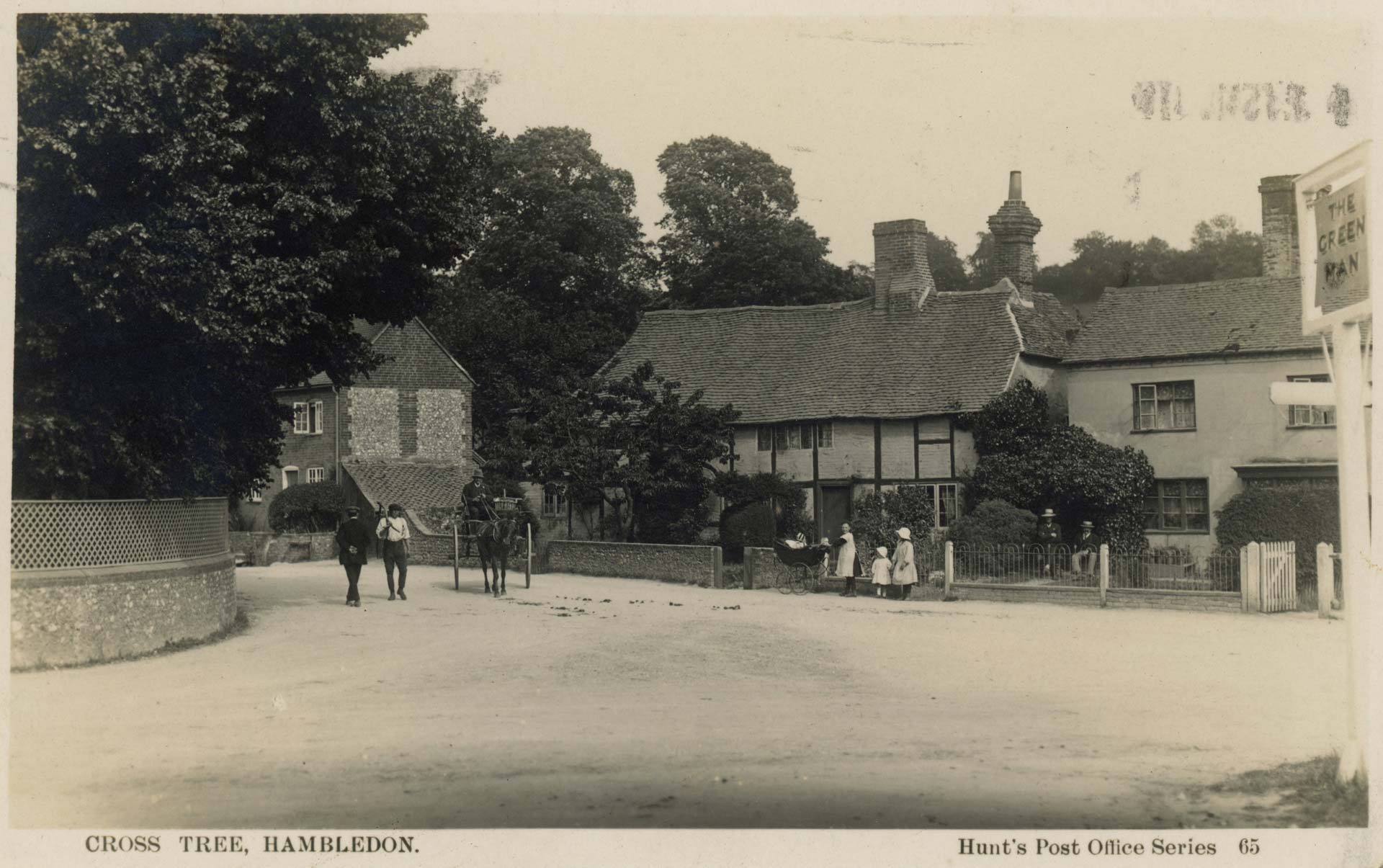
A view of the junction of Green Lane and West Street, looking east from The Green Man towards Crossways and Tudor Cottage. The flint wall to the left marks the former boundary of Harfield House's land, while the unusually broad junction shows the historic layout of this important meeting point in the village.
Click image to enlarge
Historical Information
Green Lane, classified as the B2150, heads north-northwest from its junction with West Street. The junction appears to have had its own strategic or arterial importance, with The Green Man public house on the west side and The Cross Tree, formerly two attached cottages and now a single residence, immediately beside it on West Street. A well-used footpath between the two buildings runs west towards Boarhuts Copse. On the east side of the junction is Crossways, a short lane containing two cottages.
The photograph shows the junction before later changes to the road layout. The junction is unusually broad and appears deliberately laid out that way. Today the built-out pavement and flowerbeds constrict the traffic area. Green Lane itself was originally quite narrow but was widened in the twentieth century when mains drainage was introduced to the village.
At the north-east corner is now Hambledon Barn, a converted private dwelling, adjacent to Harfield House. Harfield House once had more substantial surrounding land, including a pond believed to have filled in winter from the winterbourne that ran down West Street. The former pond site is now occupied by Upper Chapters, built in the 1980s, where an important find of skilfully worked Neolithic stone axes was uncovered. The Green Man, formerly a public house and now a private residence, is part of the historic character of this junction.